High Level Play and Scaffolding
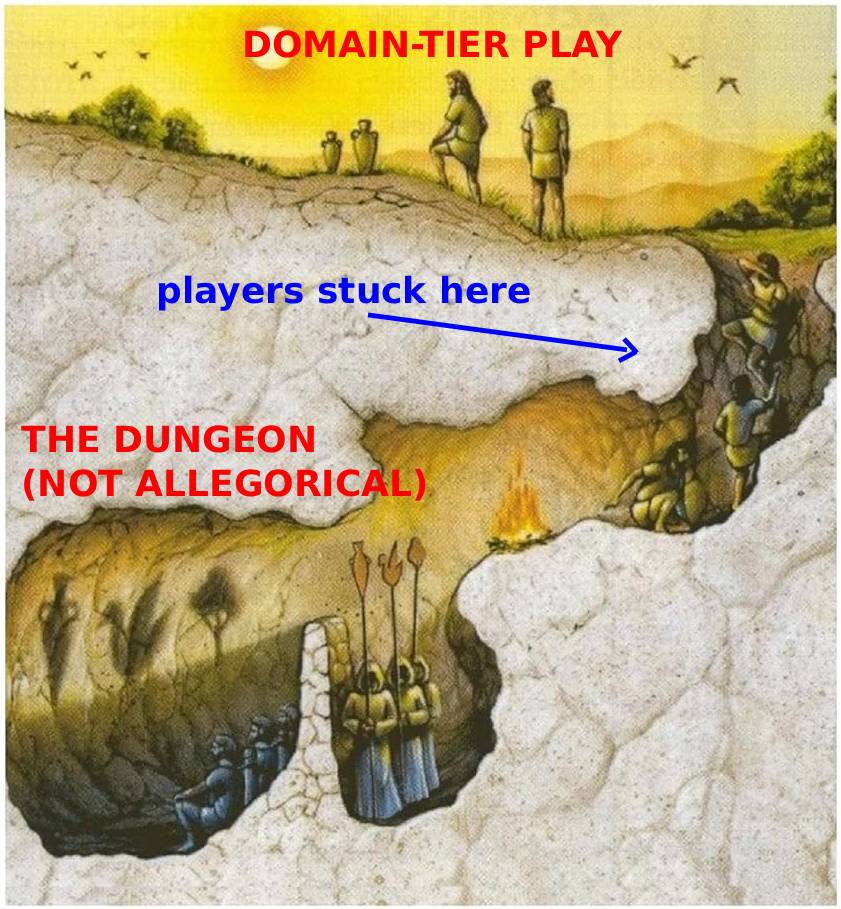
The problem of high level play
Why do players struggle when they leave the dungeon and enter the wider world?
RPG provocateur Sam Sorensen’s bsky thread on domain play prompted my thinking here. It's enough of a complete thought-arc that it should probably have just been a blogpost. Anyway, I'll quote it in full in case this blog outlives bluesky. (Sounds crazy, but you never know, right?)
one thing I have noticed in my experience running long RPG campaigns is that most players are pretty uneasy being Extremely Powerful. like "D&D as power fantasy" is a common through-line, but I've found that once they hit a certain threshold things change very sharply and you enter new territory
--
like PCs in my campaigns have reached some truly astonishing power levels—a voice whose commands must be followed, transformation into a bird larger than a castle, near-invulnerability to physical harm—and the resulting play is always really strange and off-kilter and outside normal expectations
--
I think the power fantasy commonly invoked w/r/t D&D is more like a fantasy of progression. a number-get-bigger fantasy. and that's fun, right? bigger numbers, bigger monsters. same basic loop, but you're always moving forward, always advancing through the tree. fun!
--
but actual like political power is messy and complicated. most players, I've found, feel very uncertain and sometimes even uncomfortable with the notion that they can remake the world at the end of a (+3) sword. but like, that's juicy! that's compelling! that's new and saucy play!
--
"powerful hero as monarch" has lots of good reference points in fantasy—recently I've been thinking about Daemon Targaryen in HOTD, but also, eg, Paul Atreides—but nearly always those characters bring with them heavy weights, costs, and knock-on effects. costs players are often unwilling to bear!
--
this leads me to think that a lot of the power fantasy that gets discussed in D&D is more like a... virtue fantasy. the fantasy that you get to be heroic sort of just by existing, and that problems in front of you can always be solved. which is not really the same thing as being powerful
--
but I do think genuine power fantasies are worth playing and giving thoughtful consideration. giving players a chance to genuine have massive impact over politics and law has huge potential. when players lean into it and embrace their power, it can be tremendous and affecting
Pat of To Be Resolved summarised it neatly on discord while we were chatting about cozy games:
in my mind this thread is actually a good mirror image of cozy discourse, in my mind Sam is describing a tendency for lots of players to like comfortable cozy types of violence that fit neatly into a predictable framework
And while I agree with this take, I understand players’ reluctance to enter into domain tier play.
Scaffolding
In OSR D&D there comes a point when you graduate from the dungeon and begin messing with the realm ("domain-tier play"). Forget THAC0 if you ever learned it -any experience up to this point, any rules or tricks you’ve picked up, are jettisoned as your game becomes one of politicking, making messy and complicated decisions to further your ambitions. Reportedly, career advancement is roughly the same -- get good enough at your job and you will find yourself not practicing your craft any more, but managing others to do the labour while you guide strategic-level decisions and deal with the accompanying bureaucracy.
It's a scaffolding problem. (Scaffolding is a pedagogical term, which I've borrowed from my wife, a teacher. Forgive me if I've misused it.)
An example of a scaffolding problem: I grew up with training wheels, but my son never touched them on his path to learning Bicycle. They're out of vogue.
Training wheels stop your kid from falling over while they learn to pedal, but they don't actually teach the skills needed to ride a bike once they come off. The hard bit of staying upright isn't pedalling your feet -- it's balancing. In essence, riding a bike with training wheels and riding a bike without are two different games. Instead of training wheels, kids get balance bikes these days.
Back to RPGs -- when you reach domain tier, all the scaffolding of the early tiers of play fall away to reveal a different edifice completely. You haven't learned the skills, procedures, or rules of this tier of play. Likely enough, the filthy wretch who entered the dungeon never harboured ambitions beyond accruing filthy lucre in the first place. This can lead to a feeling of whiplash for players who thought the game was one of navigating perilous spaces and facing down their denizens.
The shift happens as adventurers gain power, either mechanically -- gaining levels, accruing powerful items or magics -- or diegetically, in the form of wealth, connections, prestige or notoriety. Even games without strong mechanical advancement, such as Cairn, have a tendency to shift in focus to broader-scale concerns as play continues.
Approaches to solve the problem of high-level play
Start Slow: Theoretically, proper OSR play has you wheeling and dealing from the outset. The world is too hard to approach head-on, so you must approach it obliquely, never looking it square in the eye. Even from the beginning of your scoundrel career you must deal with, trick or manage the other factions you encounter.
This is the scaffolding that domain-tier play assumes, so that by the time you make your forays into regional politics, you have already got the experience of throwing your weight around.
Start Fresh: Progression getting you down? Don’t worry about it! Just play a variety of one-shots, starting fresh again and again whenever you complete a module.
Retirement Village: Like starting fresh, but you stay in the same game world. Whenever a character gets what they want out of adventuring, or becomes too powerful, too evil or too weird, retire them and pick up a new character. Part of the game text in His Majesty the Worm, a laser-focused dungeon delving game.
Stable Play: Not just for horses! You may not retire your more advanced characters, but they take on more of a background role while you return to your dungeoneering roots with new, lower-level characters. Another method of scaffolding, where you can dip your toes in domain-level play some of the time, without changing the nature of the game you're playing wholesale. Your higher level characters can still join you on adventures when the need arises.
Start Strong: An elegant approach -- the route that Mythic Bastionland takes. Knights start as established personages in the realm; even the lowliest knight may command a warband to their side. In this way, domain-level play is assumed to be taking place from the outset.
Picaresque play: George Constanza is unlike Goku inasmuch as he doesn’t get stronger or richer as the seasons march on. Despite more recognizably adventuring, neither Don Quixote or Fafhrd or Cugel do either. Any temporary advantage they gain is swiftly stripped from them by the narrative, to keep them in a perpetual state of striving.
To make a game like this, you must consciously limit (or periodically reset) any resources -- XP, wealth and reputation -- that might lead to the betterment of characters.
This is fun to read and watch -- after all, what's Cowboy Bebop or Firefly if the cast finally get their payout? -- but can be frustrating for players who may chafe at such setbacks. Progression is a baseline assumption in many RPGs and video games, and it can be hard for players to get into the mindset that they won't ultimately get their payday. Check in regularly to make sure it's not getting your players down.
SIDEBAR Anecdote: I played a game of Scum and Villainy where we decided at the outset that we would always be moneyless. Scoundrels that we were, we of course made away with a boatload of cash sooner or later. Getting scammed out of it at the fiction-level was a bummer even though we had decided this would be our path from the beginning. We are strongly conditioned to avoid loss, and our mindset was not strong enough to keep us playing despite it.
Shepard Tone Play: Warning: annoying to listen to (your mileage may vary with your gaming).
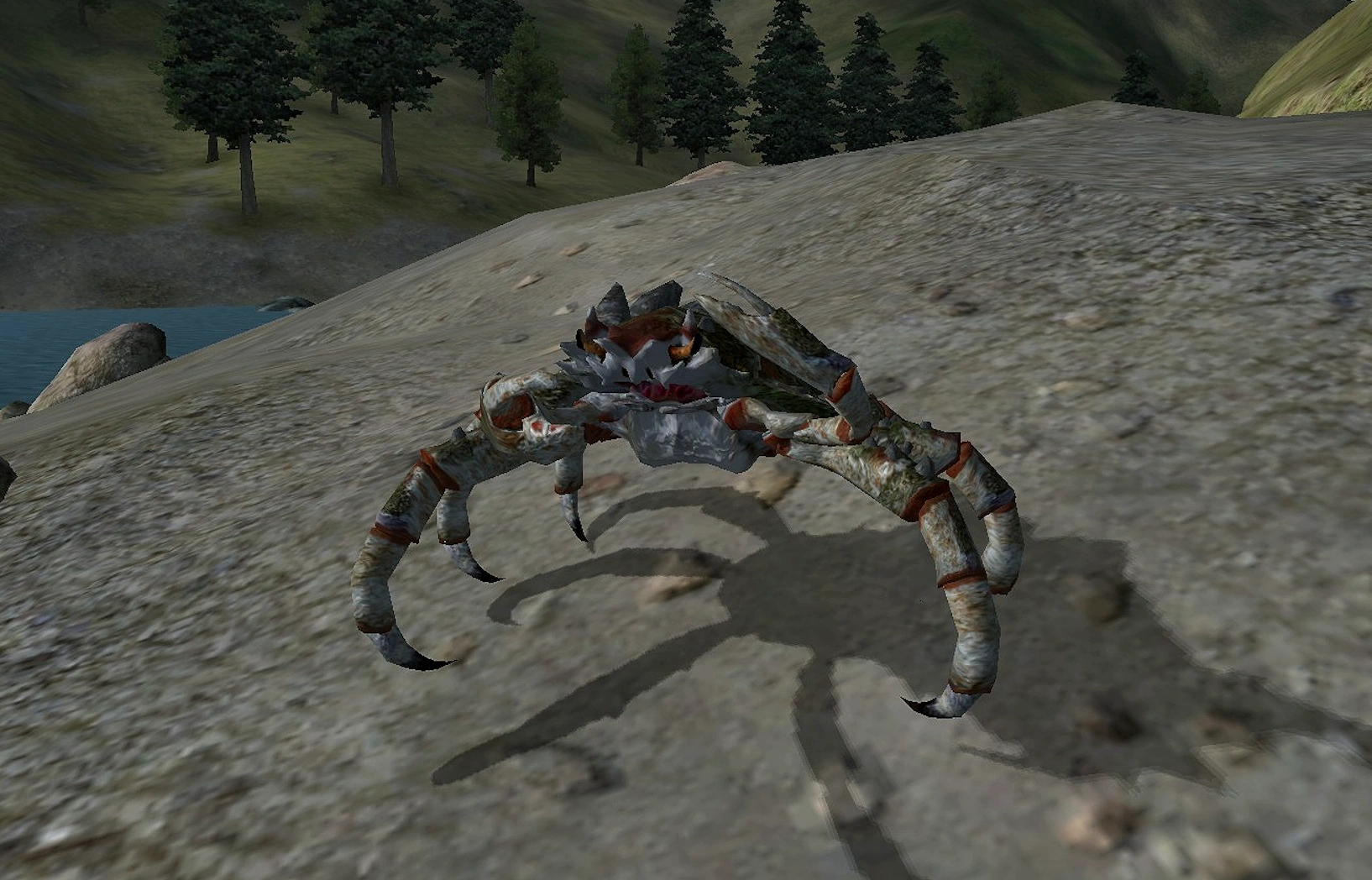
Like a Bethesda game where your enemies gain in power as you level up (anyone been one-shot by a mud crab in Oblivion?), certain RPGs have characters advance while maintaining the core dungeoneering loop. To do so, players fight mounting threats, braving ever mightier foes to keep track with their own powers. This is a hallmark of trad play, and the sort of gameplay tacitly encouraged by the higher levels of modern D&D systems.
It's worth noting that at this point, combat turns can become long, as you might have dozens of mechanically dense abilities or spells at your disposal. You often attain some level of system mastery as you engage very deeply with mechanics here. There's a scaffolding problem here, too -- if domain play becomes a spreadsheet game as you manage a military and commercial empire, 5e becomes a character sheet game.
I don't want to get into the weeds, but if you're reading this blog at all, it's probably not your favoured mode of play. I've had fun with it, but my boredom with this exact dynamic led me to the OSR.
Postscript
So then to Runequest, and to Glorantha, and the best high-level play I've enjoyed. I found the late-game very satisfying, mechanically and narratively because of gameable metaphysics.
Skills and stats might crawl upwards in Runequest, but the main avenue of your advancement is through your involvement with your tribe and with your cult. The default mode of play has you integrated into a community -- if you're on a quest, it's because your priestess, your shaman or your chieftain told you to.
At the same time, the spiritual and the material are linked. The metaphysical is always right there in the fabric of your game.
SIDEBAR: "Heroquesting" is something that goes like this: Say that you can't cast fire spells because your god lost a big fight against the god of darkness in the myths. WELL, if you were to step back into that myth and walk in the shoes of your god and go and win that fight (which will be hard because it's not the way the myth is supposed to go), then you could now come back and your clan could command fire now. (Except note that you perhaps failed to learn the real lesson of the myth, which is humility.)
High-level play may involve politicking, but since the hinge of the world is mythical, play still incorporates adventuring. Meet your foes on the battlefield if you want, but if you truly want to defeat them, you must engage them on the spiritual plane. Essentially you are going and making a metaphysical argument that victory should be yours.
Your sword fighting skills are important here -- they will be tested against gods or their champions -- but mostly inasmuch as they represent your ability to reenact your god’s deeds. That is -- to embody your community’s values and virtues. And in doing so, as a player, you are becoming more familiar with the myths of your god, how they might act and think, and what that might mean in play.
There's something I love here, which is that as you progress, play does change in nature, but you are being scaffolded to integrate more deeply with your character and their community on multiple levels. More than anything else, I appreciate that Glorantha has metaphysics with blorb. Being invited to step in and have an impact in this way truly does feel like high-level play.