A Handle for Hidden Information
Information Asymmetry
The world doesn't give itself over to players without effort.
In an adventure game, some parts of the world will be hidden from view. I'm with Ben L when he says:
the pleasures of secrecy and discovery are at the heart of roleplaying. One reason why the OSR style of play appeals to me is that makes this pleasure easy.
This post is about what information is hidden from players, and how it is revealed.
These concerns hold as much for writing adventures as running them. Yochai's recent post, The Keys to My Heart, compares various keying styles in written adventures. Reading this, it's clear that Keying Styles are tools to organise information around the player-referee divide. Information asymmetry is a defining factor of this style of gaming. Again, Ben L. has the right of it:
[The pleasure of discovery] depends on a differentiation of roles between DMs and players... In the OSR style of play, [the referee's job] is essentially stocking a storehouse of secrets. The players, by contrast, go into the situations they choose to enter in a state of ignorance.
The Toolkit
We're lucky in the hobby to have a great toolkit for referees to manage the availability of information for players. Anne's classic blogpost lays out three tiers of information: Landmark, Hidden, Secret:
"Landmark information is automatic and free."
"Hidden information isn't automatic... and it often isn't free."
"Secret information is... the opposite of automatic, and it's always expensive."
A metaphor: Think of an iceberg floating in the ocean. Jutting from the water is landmark information. Seen hazily through the surface is hidden information. Deep beneath, where you must certainly dive into the frigid brine, is secret information.
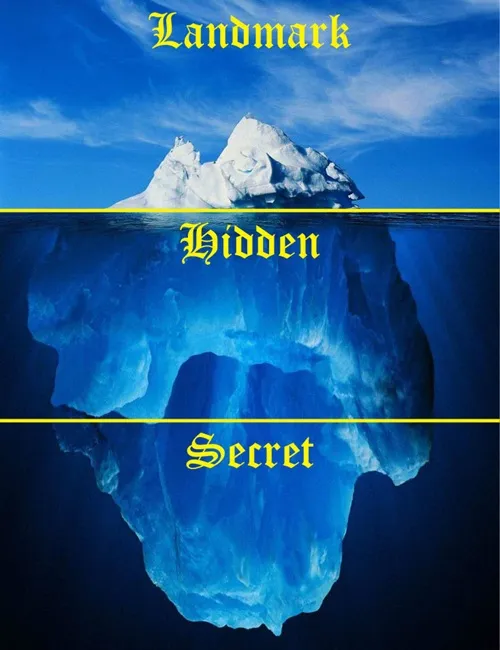
The framework applies all over the game world -- physical spaces such as dungeon rooms and wilderness locations; character qualities, such as the characteristics and agendas of NPCs, or the strengths and weaknesses of monsters; abstract game elements such as the workings of magic or the details of a conspiracy. Anything with enough complexity to be more than meets the eye can be unpacked in this way.
While the most successful keying styles make the contours of the information divide obvious to the referee, I find the game runs more smoothly when these contours are also obvious to players - that is, players can see what parts of the game world they can poke at to reveal more information.
Handles
To facilitate players investigating the game world, you can provide them with a handle - some fact that points towards a more hidden fact. A handle is a bit of information that players can grasp to drag hidden information into the light.
Why a Handle? Think of Chihiro in Spirited Away, delegated the task of assisting the disgusting Stink Spirit at the bath house.
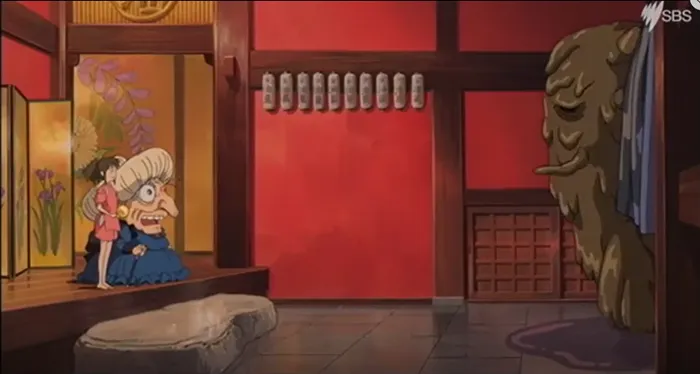
Earnest and diligent and brave, she engages with the task no one else wants to. She falls in to the goopy body of the spirit and discovers hidden information: a bicycle handle jutting from the muck.

Pulling on this handle with the coordinated effort of the entire bath house, they extract decades worth of accumulated muck. The true form of the river spirit is restored, and Chihiro is rewarded.
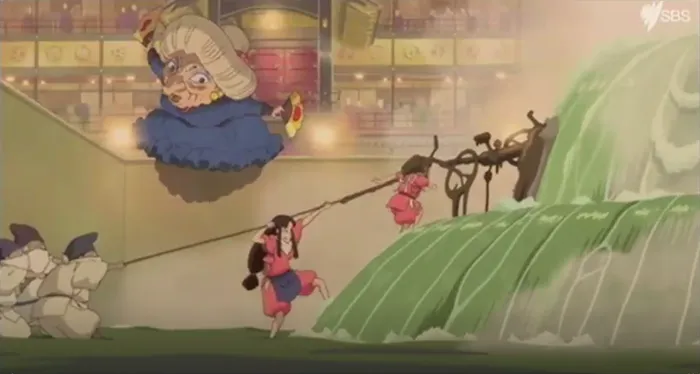
We can map this to our iceberg diagram.
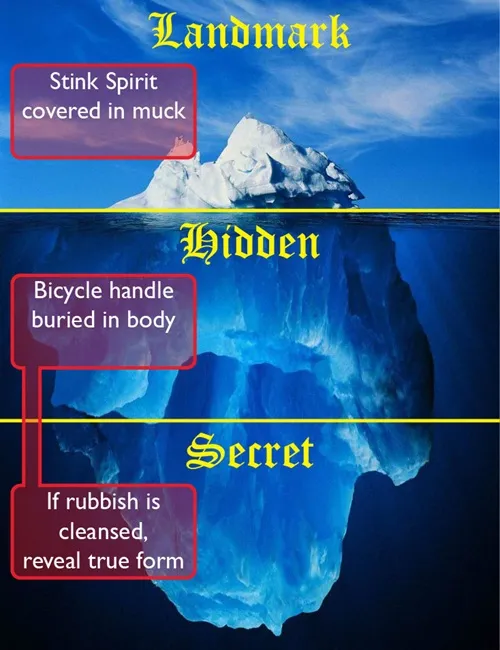
All hidden information acts like this. You find a handle, and you pull on it.
Handles in Play
Let's turn to an example from a written key - this is straight out of Yochai's post. His keying uses H and S to denote Hidden and Secret information.
- H: Boot prints are visible in the dust. They lead to a spot on the west wall, where a small gap in the dust is visible on one of the floorboards.
- S: Pressing down on the far end loosens the board. Hidden beneath is a jewelry box with 423gp inside. A string on the bottom is attached to a poison needle trap (d4 DEX damage) hidden in the wall. Cutting the string disables it.
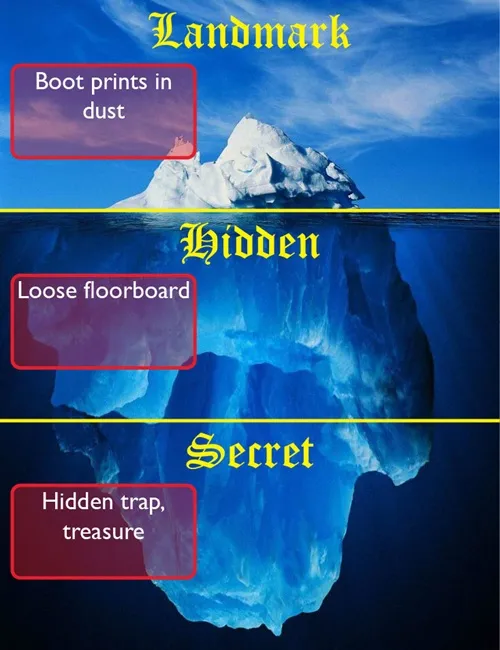
Despite falling under the H header, I'd argue that the boot prints present themselves at a casual glance. They are a landmark fact, and thus act as a handle for the other hidden information in the key.
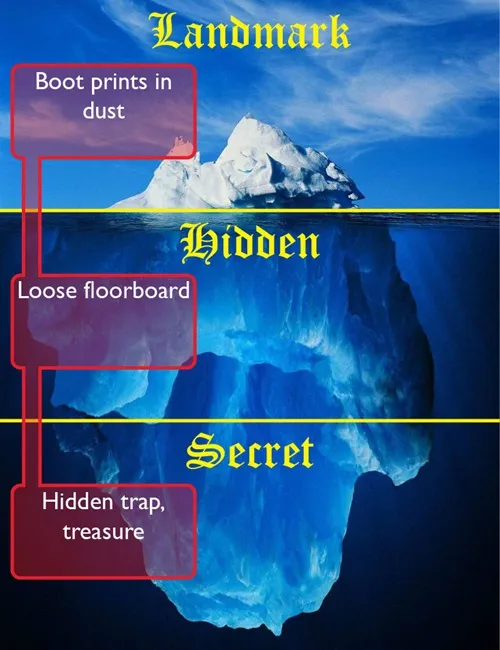
You might even say that the entirety of the H information is a handle for the S information - players who choose to investigate the floorboard will come to find the treasure and the trap. This is a ladder of discovery, where each rung naturally leads to the next - curious and diligent players need only grasp each handle in turn to uncover mysteries in the world. I'll return to this idea in a minute.
A Note on Landmark Information
Don't forget: landmark information represents anything that would be clear to a character in a scene. It is information given freely, but this doesn't mean that an initial description of a situation needs to include every landmark detail in the scene. I'll quote Anne at length:
You actually don't have to give a detailed description of everything the characters can see when they first enter a room. In fact, you probably shouldn't. Down that road lies madness, and ten-minute long read-aloud text. It's probably better if your initial description is short and evocative, if it sets the mood and lists the items available to investigate, and then gets out of the way. That doesn't mean all the other information is hidden. For many items on that list, your additional description should be free, and should be as detailed as the player would like.
Anne is careful to say there is a difference between landmark information that is given as a baseline, and that which, while free, must be asked for.
So while the boot prints are a landmark fact, this doesn't mean you have to point them out when players enter the room.
Handles are clues
In another context, you might just call a handle a clue. But "clues" imply a formal investigation, whereas our Toolkit might apply to any part of the game world. But like clues, a handle might not be a single fact in itself - it could be an assemblage. Take the example from my last post, about an old veteran travelling incognito:
She trudges the road in her dusty travel clothes. She has lined features and a scar down her cheek. She carries a simple but well-maintained sword, marches steadily despite her slight limp, is efficient and fastidious when she makes and breaks camp.
No single fact in her description points towards her being a veteran, but taken together they indicate this hidden piece of information. If the players had, for instance, heard a rumour about a veteran running from the law, they might be alert to these things.
A handle is a way to shape the contours of the information asymmetry between the referee and the players. These contours might change based on the circumstances of the scene (e.g. a party without a light will never find the boot prints in the dust), or the characters in it (e.g. a mercenary character might immediately recognise the veteran for what she is).
The biggest determinant of the availability of handles -- and the reason it's worth talking about them at all -- is to control friction and pacing.
Friction
Generous use of handles reduces friction in the game. The more information is presented to players up-front, the less frictional the game will be.
Let's talk about friction for a second. To take an example of frictional design, here's an excerpt from the section on Roleplaying in Arnold K's GLOG:
If you don't understand that bootless goblins are susceptible to intimidation, and proud dwarven kings are not, you are bad at this game.
Common sense negotiations are one of the skills that this game tests.
There are certainly tables (and games) where this understanding is not tested. That's all well and good, but it's a different sort of game. Friction isn't inherently good or bad: the amount of it and where it can be found influences the texture of gameplay. I'd even argue that emphasising forgotten pockets of friction led to the OSR's birth, and that learning better where to utilise friction is a core concern of modern OSR design.
Tests
Friction is a tool the can be deployed intentionally. It comes wherever the game tests your players or their characters. In general it can point to where the game is. With that in mind, how prominent we make our handles is a function of what the game's focus is on.
Remember that tests are a conceit in storytelling, too. Think of Chihiro again. She only discovers the handle for the secret of the stink spirit once she's neck-deep in it - the handle is itself hidden. This is fairytale logic at play - to find the handle at all, she had to be courageous, diligent, humble.
Some games make information-gathering relatively easy, and focus on the consequences that flow from the information learned. In Mythic Bastionland, Chris McDowall says:
The players can only make interesting choices when they are presented with difficult situations and given all of the information needed to engage with them.
In many of his interviews he emphasizes that he generally gives players as much information as they ask for, or more. Elmcat is of a similar mind, even in mystery games:
Withholding information doesn't make your mystery more mysterious or harder. It usually just makes the mystery harder to access, or even to notice... A mystery isn't a lack of information. It's a lack of understanding.
In an extreme example of this line of thinking, Nate Lumpkin advised this in 2019: "Tell the players when NPC is lying, unless NPC is really good at lying." He's not alone, either:
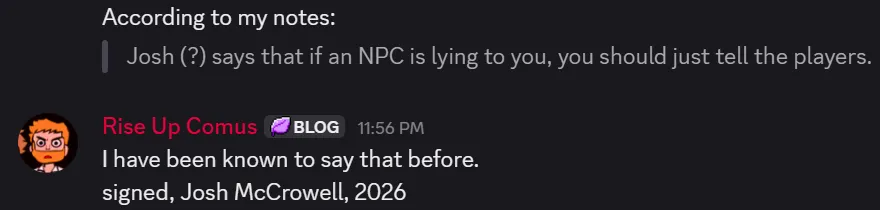
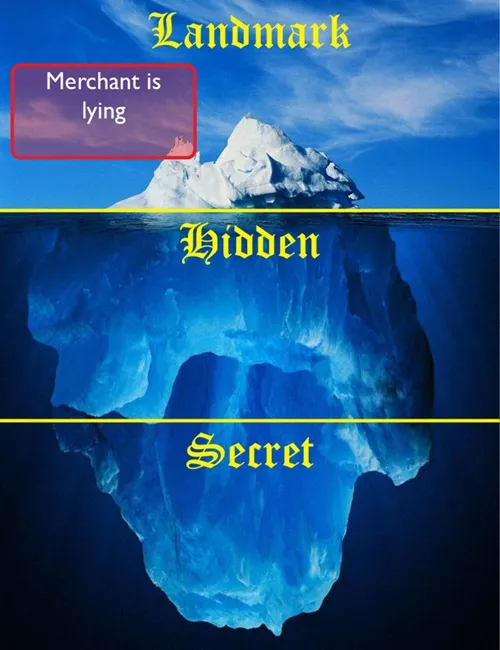
This style of gameplay is not testing how good players are at noticing duplicitous NPCs, it is testing how players react to them.
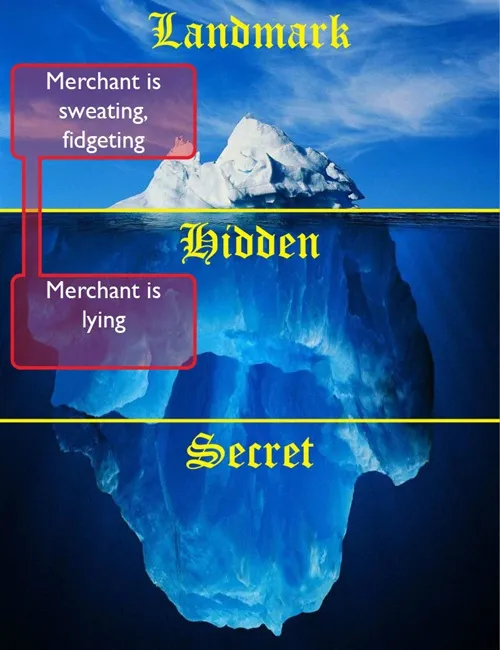
vs
The Ladder of Discovery
This technique - placing critical information in the Landmark tier - is a way to ensure players find the information they need to engage with the game. A gentler technique is to build a ladder of discovery, so that there is a progression of information from Landmark to Hidden to Secret.
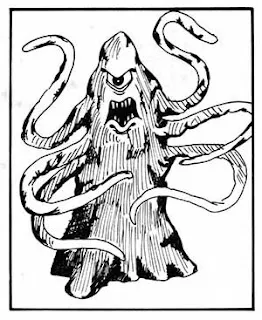
To explain, let's look at the opposite case: "living Gotcha! traps". Cloakers, Lurkers, Ropers, Trappers, Gelatinous Cubes - monsters that camouflage within a dungeon.
Take the Roper:
The roper is a classic D&D monsters that comes from the earliest incarnations of the game. It sits motionless, pretending to be a stalagmite until an unsuspecting adventurer passes by, whereupon it attacks with its six tentacles.
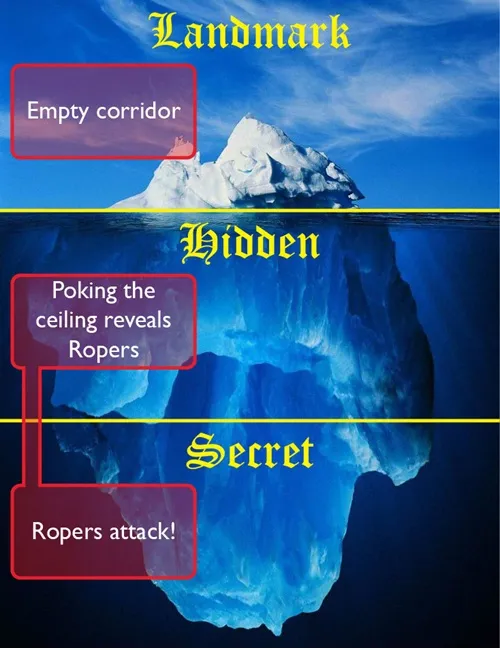
There is a broken ladder of discovery here - nothing points to the hidden facts of the room. Contrast this with Yochai's bootprints from before - there is a logical sequence of handles, where investigating each element reveals the next-most-hidden element.
Pacing
Because they can easily take out a low-level character, Gotcha! monsters teach players to creep five feet at a time, poking walls, floors and ceiling with a pole. You won't find them at Chris McDowall's table ("the more dangerous something is, the more obvious it has to be."), nor will you find them at mine. But this doesn't mean a "broken ladder" is always an example of bad adventure design.
Think of Arnold K's advice in his Dungeon Checklist, to include Something the Players Probably Won't Find.
I think it's important to hide things because there is a sincere joy in exploration and testing the limits. If all of the things in a dungeon are obvious, why even bother wondering what is at the bottom of the well?
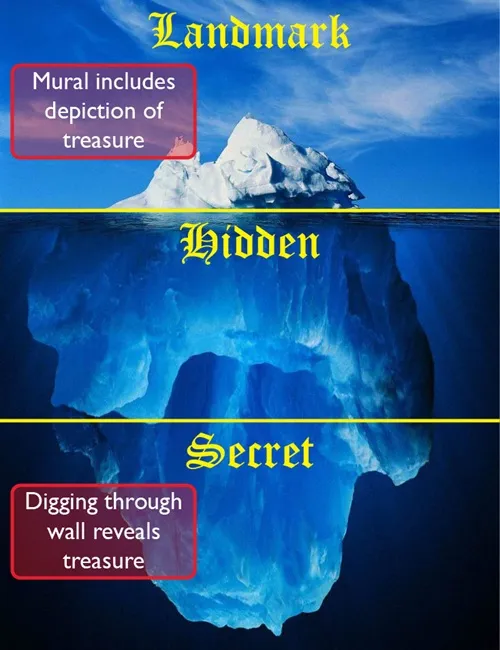
Again, there is a broken ladder of information here - no handle on the secret, no sign that there's something worthwhile to be dug up. Finding the treasure here requires luck, chutzpah, inspiration, a leap of logic. All wonderful things to reward in an adventure game.
So handles are not necessary for every bit of information. Instead, they are a tool that lets you control friction and pace your game through the flow of information. By varying the amount of information in different parts of your game, you can create a variegated texture that keeps play moving while rewarding investigation.
As with all tools, friction in information design should be used intentionally. I hope the idea of handles helps you manage it at your table.
This post was inspired by my friend Jonas who's been doing atomic blogposts - taking a single idea from a larger work and putting it under the electron microscope. My last post was a bit niche, perhaps a bit woolly, but tucked away was the idea of a handle for hidden information. Thanks Jonas.